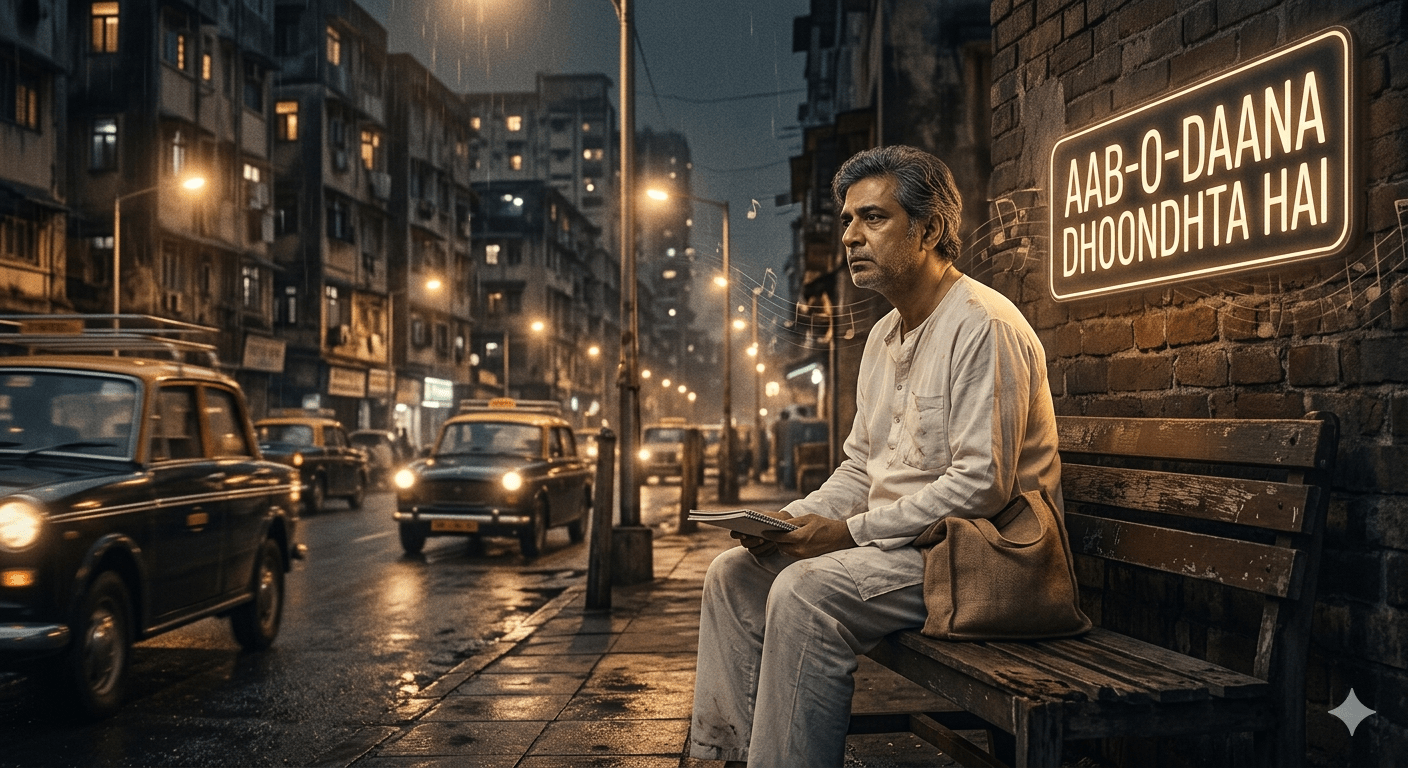
The concrete maze of Bombay has a way of swallowing dreams whole, but perhaps nobody felt that crushing isolation quite like the legendary composer Jaydev.
The haunting melody of “Ek Akela Is Sheher Mein” (from the 1977 film Gharaonda) is often remembered as a anthem for the urban lonely. But the backstory carries a sharper, more tragic sting. Jaydev wasn’t just composing a song about a displaced protagonist; he was scoring his own reality. For years, the maestro who gave Indian cinema some of its most soul-stirring music didn’t have a permanent roof over his head in the very city he enriched. He spent decades drifting from rented rooms to friends’ apartments, searching for a home—a quest that remained unfulfilled when he passed away in 1987.
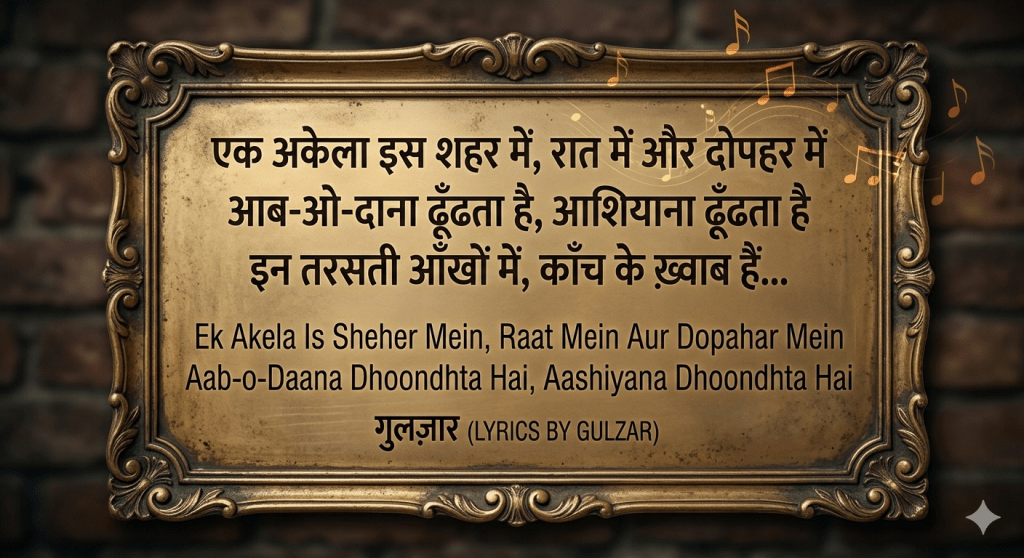
The lyrics, penned by the brilliant Gulzar, became a mirror to Jaydev’s own desperate search for aab-o-daana ( Dana & Pani ) in a city that trades in gold but pays in solitude.
The Anatomy of Urban Frustration:
When you listen closely to the couplets, you don’t just hear music; you hear the quiet, exhausting sigh of a creative genius wondering where he belongs.
“Ek akela is sheher mein, raat mein aur dopahar mein,
Aab-o-daana dhoondhta hai, aashiyana dhoondhta hai.”
Aab-o-daana literally translates to water and grain—the bare minimum required to survive. But combined with aashiyana (a nest), it becomes the ultimate cry of the displaced. The frustration here isn’t loud or angry; it’s the exhausting, repetitive cycle of searching “in the night and in the afternoon.” The city doesn’t sleep, and neither does the anxiety of the homeless.
“In tarasti aankhon mein, kans ke khwaab hain,
Kaanch ke khwaabon mein, ek chehra aashna dhoondhta hai.”
How beautifully, yet brutally, this captures the deception of the metropolis. The eyes are tarasti (yearning), but the dreams offered by the city are made of glass (kaanch)—fragile, sharp, and prone to shattering at the slightest nudge of reality. In that sea of broken glass, the poet-composer isn’t looking for luxury; he is just looking for ek chehra aashna—a familiar, welcoming face. A place to rest his weary eyes.
“Jee mein aata hai, sab ulat pulat kar dein,
Is badalti duniya ko, ek pal mein thamm kar dein.”
Here, the helplessness turns into a quiet, simmering rage. It is the urge of a tired soul who wants to turn the world upside down, to just make the relentless, fast-forward motion of the city stop for a single second so he can catch his breath. But the city stops for no one, not even its sweetest song maker.
An Unfinished Melody
There is a profound irony in the fact that Jaydev created melodies that comforted millions, yet he died before he could secure a comforting space of his own. He was a king of notes, but a nomad of the streets.
They say he was still looking for that elusive apartment, still trying to stitch together a permanent address in Bombay, when his heart finally gave out. The song was completed and immortalized, but the life behind it remained a fragment.
Next time you hear those melancholic flute notes and Bhupinder Singh’s heavy, baritone voice echoing through your speakers, remember that it wasn’t just fiction. It was the sound of a man looking out of a window that wasn’t his, into a street that didn’t care, humming a tune for a home he would never get to unlock.
Jaydev eventually found his peace, leaving the restless city behind. And perhaps, somewhere beyond the crowded bypasses and towering skyscrapers of this world, the maestro finally found his aashiyana—where the rent is never due, the music never stops, and the soul is finally home.

