(The Nadi Stuti Suktam) RV:10.75 [5-6]
What was the extent of Aryavart during the Vedic period?
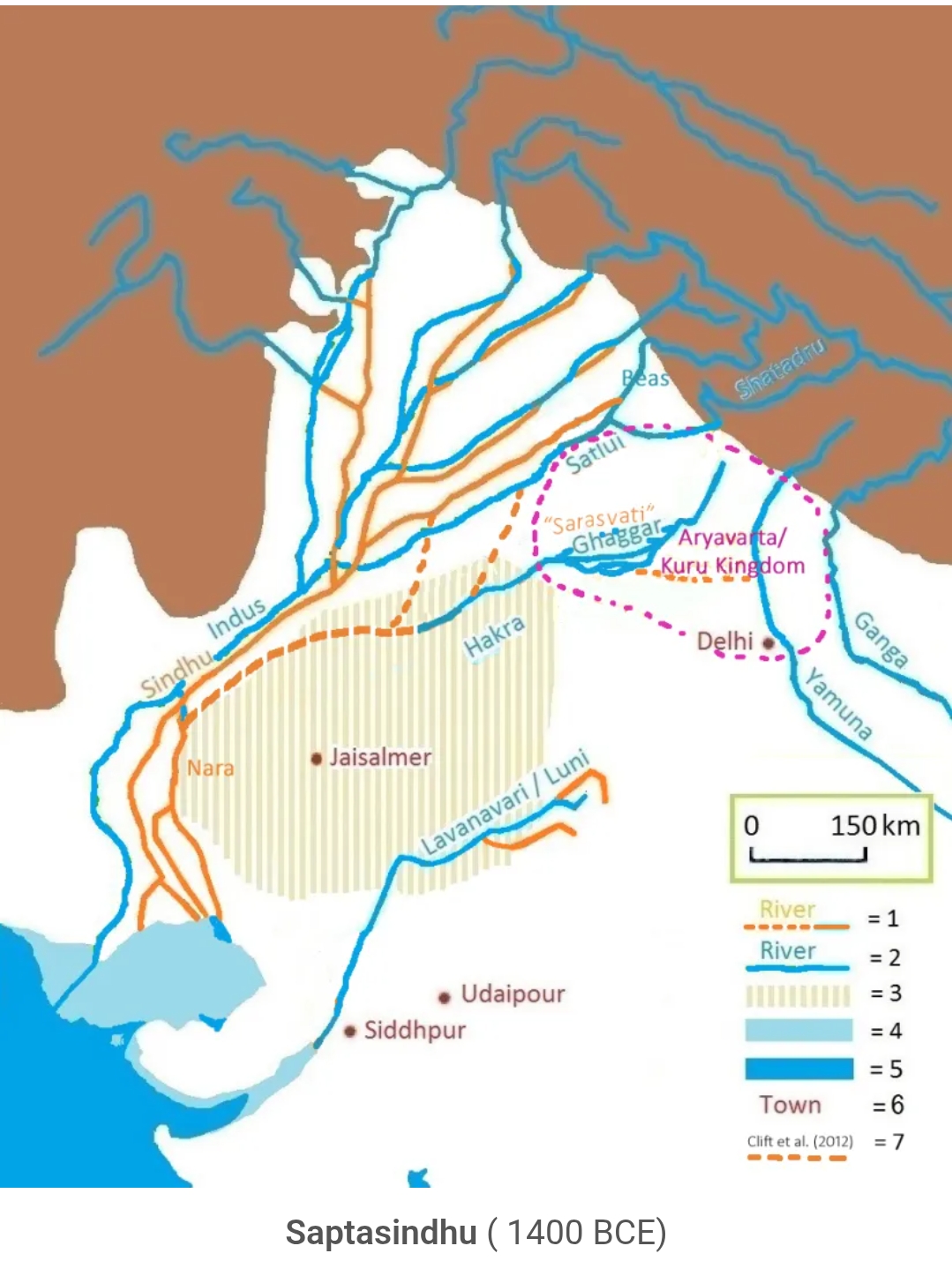
The Nadi Stuti Sukta (the “Hymn in Praise of Rivers”) is one of the most geographically significant hymns in the Rigveda, providing a detailed map of the river systems in the Indian subcontinent during the Vedic period.
The Nadi Stuti Sukta is found in the Rigveda:
- Mandalam: 10
- Sukta (Hymn): 75
Composition Period of the Nadi sukta is 1500 BCE – 1200 BCE.
Rigveda is the earliest of the four vedas composed by the Arya Rishis. The bulk of Rigveda Samhita is accepted to have been composed between 1500 BCE and 1200 BCE. It consists of 10 books- 10 mandalas. The 10th Mandala is the newest of all the 10 books. The 75th hymn of this tenth mandal is captioned as the Nadisukti Sukta. it chronicles all the rivers of the vedic time. Rivers with which the Arya Rishis were acquainted.

The following pic captures the verse no 5 and 6 of the 75th hymn of the tenth Mandal of the Rigveda. It is noted as Rk 10.75 (5-6). transliteration in Devanagari and the English translation of these two shlokas are given after that.

इमं मे गङगे यमुने सरस्वति शुतुद्रि सतेमं सचता परुष्ण्या |
nadistuti sukta ( 5,6)
असिक्न्या मरुद्व्र्धे वितस्तयार्जीकीये शर्णुह्यासुषोमया |5
|तर्ष्टामया परथमं यातवे सजूः ससर्त्वा रसयाश्वेत्या तया |
तवं सिन्धो कुभया गोमतीं करुमुम्मेहत्न्वा सरथं याभिरीयसे |6
The shloka 5 translates like this
O Ganga, Yamuna, Sarasvati, O Sutudri and Parusni
Asikni, Vitasta, O Marudvrdha, O Arjikiya with Susoma hear my call.
Nadistuti Sukta (shloka 5)
- These are the name of rivers in the shloka from east to west:
- Ganga
- Yamuna
- Sarasvati
- Sutudri ( Sutlez)
- Parusni ( Ravi)
- Asikni (Chenab)
- Vitasta (Jhelum)
- Arjikiya (Haro- river in Pakistan)
- Susoma (Soan River in Pakistan)
The shloka 6 goes on to add another 4 rivers from the Indus further west. ( Western tributaries of Indus.)
First with Trstama thou art eager to flow forth, with Rasa, and Susartu, and with Svetya here, With Kubha; and with these, Sindhu and Mehatnu, thou seekest in thy course Krumu and Gomati.
Nadistuti Sukta (shloka 6)
- Verse 6 adds the following 4 rivers:
- Sindhu ( Indus)
- Kubha ( Kabul river)
- Gomati (Gomal river flows in Afganistan )
- Kurumu ( Kurama is a name of river in Pasto language of Afganistan)
In the whole of Rigveda, the river Sindhu is described to have the most powerful flow. It is the modern Indus River. Next important river is the Sarasvati followed by the Drisadvati. The land between the Sarasvati and the Drisadvati is known as Brhmavarta where the vedas are created. The River Ganga remains the boundary on east of the Rig vedic geography. It is mentioned only once in this Nadistuti Sukta as if to complete the list. So much importance Ganga could muster. What to speak of Kalinga, Assam, Chola and Chalukya.
(Table Showing the important rives in the Vedic text.)
| Modern Name | Rigvedic name | Location | Remark |
| Indus | Sindhu | Pakistan | Mightiest river in the Sukta. Lifeline of RV. Part of Saptasindhu. |
| Jhelum | Vitasta | J&K, Pakistan | These 5 rivers Constitue Punjab and also part of Septa sindhu |
| Chenab | Askini | Jammu India, Pakistan | |
| Ravi | Purushni | India, Pakistan | |
| Beas | Vipasa | ||
| Sutlej | Sutudri | India, Pakistan | |
| Ghagghar-hakra | Sarasvati | Haryana, ends in Thar Desert. | In Early Rigveda it is described as Great and Holy river. In Post vedic period as Goddess Sarasvati. Part of Santa Sindhu |
| Chautang | Drishadvati | Haryana | |
| Haro | Arjikiya | Khyber, Pakistan Punjab | |
| Soan | Susoma | Islamabad, Pakistan | |
| Kabul | Kubha | Afganistan | Drains into Indus. Main river of Afganistan |
| Gumal | Gomati | Afganistan, Pakistan | Gomal University and Gomal District in Pakistan. The name migrated east ward to UP as Aryans migrated east. |
| Kuramu | Krumu | Khybar, Pakistan | |
| Gilgit | Trstama | ||
| Swat | Suvastu |
The Rig Vedic Geography stretched from the river Kabul in west to the western boundary of Ganga in the east. It occupied Eastern part of Afganistan, whole of present Pakistan and the Haryana, Jammu and Punjab of India. Two of the important characters of Mahabharata: Gandhari, Shakuni belonged to Kandahar in Afghanistan. Madri, the wife of Pandu belonged to Afghanistan. Taxila was on the river Soan was located near today’s Islamabad.
Beyond the Bolan pass, a contemporary people were composing Avesta when Aryans were composing Rigveda in the Saptasindhu region. In the Avestan tongue, ‘s’ sound is replaced by ‘h’.
By the side of Helmand river ( Afghanistan, Iran border) Avesta describes Haptahindu with 16 janapada. They would pray Ahura and despise Devas. They also had a sacred river Harahuvati. By the side of Indus, Devas are praised and Asura is despised. Sarasvati flowed and Saptasindhu flourished.
What a coincidence! As if two brothers who have separated and vowed to do the exact opposite to each other.
Avestan are fire worshipers and occupied 16 janapadas in Ariana. ( This word phonetically sounds so close to both Aryan and Iranian). Today we call them Zorasterians of Iran. Aryans occupied Saptasindhu and established Vedic civilization. They also worshipped Soma and fire sacrifice ( Yagna ).
The words Aryan and Iranian have a common root. In Sanskrit, the word Arya was used as a title of respect, much like “Sir” or “Noble”. Anything ignoble is called Anarya. Iranians call themselves Ariya, but the Greeks addressed them as Persian and the name struck. The modern name of the country Iran is derived from the word Arian.
Avesta & Rigveda .
The ancient scriptures of Persia is called Avesta. It is a contemporary of the Rigveda.
Avestan (Old Iranian) and Vedic Sanskrit (Old Indo-Aryan) is so close they are considered to be two dialects of the same ancestral language. The only phonological shifts between them is the s > h change.
In Avestan, the sound s changed to h in most positions, whereas in the Rigveda, it was preserved as s.
Comparative Word list between Rigveda and Avesta
| Meaning | Rigveda (Sanskrit) | Avestan (Old Iranian) |
|---|---|---|
| Seven | Sapta | Hapta |
| Sun / Shield | Svar / Sūrya | Hvar |
| Assembly / Society | Sabhā | Hazā |
| Soma (Sacred Drink) | Soma | Haoma |
| Truth / Order | Ṛta (Satya) | Asha (from Arta) |
| Army / Host | Senā | Haēnā |
| The Region / River | Sapta Sindhu | Hapta Hendu |
| Well-being | Su- (prefix) | Hu- (prefix) |

