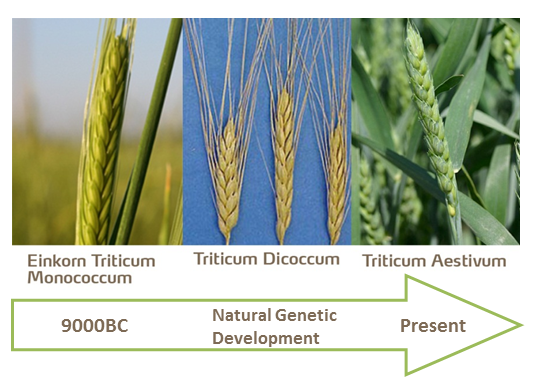
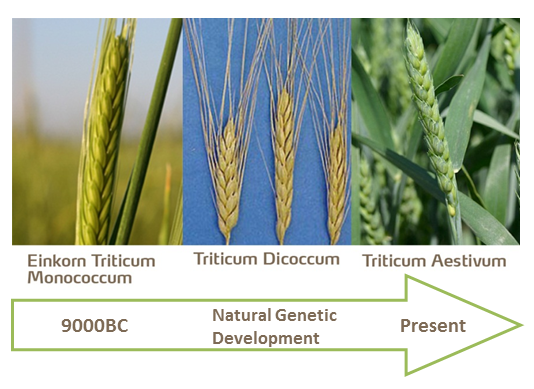
( Wheat is the staple food of millions of people. Although rice is the second largest produced cereal in the world, its production is localised only to Asia. The cultivation of wheat was started some 10,000 years ago, with its origin being traced back to south east Turkey. Along with agriculture, we became a mammal of farmer- shepherds. In the process we picked up Zoonoses from our domestic animals. Now one such animal virus is bent upon wiping out the species HOMO off the face of earth. )
The hunter gatherers:
For 2.5 million years humans on the planet earth survived by plucking fresh fruits and nuts from trees and gnawing raw meat of hunted animals. They moved in small bands from forest to forest in Africa foraging for food. They never bothered about growing or storing food in one particular place. They were nomads.
Farmers:
Around 9000 BC, few sapiens from the Turkey, Iran, Levant area planted wheat for the first time in the earth. Instead of searching for wild wheat here and there on the banks of rivers of Mesopotamia, they thought, why not prepare the field and sow some of the wheats and take care. It was a hit. They realised that they can gather 10 forest load of staples from one small field. Now they don’t have to roam from forest to forest braving wild animals for their daily calorie need. Villages are created and the nomads settle down to farming and raising cattle.
While wheat grew by the river Tigris, sapiens by the river Yangtze raised paddy and Incas of Peru cultivated potato. Now the sapiens lived in villages.
The history of village is only 10,000 years.
The history of our nomad ancestors’ on this planet is a whooping 2.5 million years.
_R.K.Mahapatra
Virus:
Viruses were there inside the forests of Africa for billions of years. They are the simplest form of life consisting of one strand of a piece of nucleic acid with an outer coat. Life means a thing that can propagate its species against all odds.
Life means a thing that can propagate its species against all odds.
_R.K.Mahapatra
In the celestial laboratory of nature, atoms of Carbon. Nitrogen, Hydrogen and Oxygen combine randomly in presence of Sun light and warmth to form random nucleic acids. Few of them can gather life and infect a living host. Corona virus is one such RNA virus. It is really very tiny. One thousand SARS viruses can crowd on the tip of one single human hair. In such a tiny body, they have no other provision except the code to self replicate. They need one living cell ( plant or animal) to infect, survive, divide and grow. In the process the cell dies. The life force in the infected animal naturally has to counter the virus. It develops immunity and kills the virus completely.
“Immunis” in latin means exempt.
When such a virus had entered a nomad Sapien in the wild Africa say a million years ago, there were three possibilities.
- 1. If the virus is highly contagious and lethal, it will infect the whole band of nomads and kill them and go extinct. Period.
- 2. The band of sapiens get sufficient time to develop immunity and the virus is killed off. The end of the virus species.
- 3. There is a middle path, when the virus and our immunity adjust to each other and coexist. For example, the Herpes Zoster virus. It enters us in our childhood and remains in the custody of our immunity restricted only to few nerve cells. Whenever our immunity fails, the zoster blisters come up. We have a name for them- the *fever blisters*.
…
This dynamics changed as we settled down in villages. As our communities grew in size, viruses got more hosts in one cluster to infect and survive longer. At least 80% of the community must be immune, before the virus can be contained. This is called *Herd Immunity*.
This happened with AIDS. In the deepest forest of Congo, where the *Bantus* killed chimpanzees for dinner, the Chimp virus usually infected few bantu tribal people. It usually had a dead end for at least two millennia.. Either the handful of bantus died or got immune and lived with the virus inside them. This balance changed when the Colonisers from France and Denmark landed on the coast in search of Timber, Minerals and slaves. They built train line into the heart of the tropical forest, created port settlements on the coast. They had to engage thousands of local tribes. The AIDS viruses hitherto limited to the Chimps of deep forest, got hold of thousands of non immune European hosts. From the colonial township of Leopoldoville by the river Congo, the virus boarded the flight to Haiti along with the UN Social workers deputed to work in Congo.
Haitians, Hemophiliacs, Homosexuals and Heroin addicts constituted the 4H of the AIDS epidemic of USA.
Two viruses that has changed the world history for ever.
As the spaniards attacked the Latin America they infected the native Incas and Aztecs with small pox. It is said 90% of the natives succumbed to small pox. The Spaniards were already immune to the virus from their childhood and won. History changed again when the army of Napoleon succumbed to Yellow fever by the river of Mississippi ( Saint-Dominique epidemic,1802) and Napoleon was forced to sell Luisiana to USA. History was written again when the American revolutionary army succumbed to Small pox. ( The battle of Quebec, 1775). Had they won that day, Canada would have been part of USA now.
Zoonosis–
As our forefathers settled down to the comfortable life of farming and community living, some of the deadliest viruses jumped on us from the domestic animals. We got Measles from sheep, Rabies from dogs, MERS from Camels, a varieties of influenza from pigs, chickens and some deadly brain fevers also. What is important in Zoonoses is that even if we are immune, the viruses stay in animals, mutate and can infect us again and again. Therefore we are getting seasonal influenza despite having a good vaccine for more than half a century. This is also happening with the Covid-19.
Globalisation is the last nail on the coffin of the Sapiens.
We know that though the Covid-19 germ broke in Guangdong province of China first, it reached Italy before it can travel to the capital Beijing. There was a direct trade link between these Chinese province and the cloth merchants of Milan of Italy. Last year, as the train services resumed, the virus reached Berhampur of Odisha overnight from Surat of Gujarat.
Prior to 1995, the diseases of bats were regularly breaking in the Chinese hinterland and were dying down quickly. But on July 1, 1997, Hong Kong was handed over to China. Now these exotic viruses got in to Hong Kong and from there escaped to the world at large within no time. These unknown viruses are also getting identified quicker with the advanced labs in Hong Kong. You will be surprised if you count the number of epidemics that has scourged the whole world since this momentous event.
We have the Bird flu in 2002, Swine flu in 2009, MERS (Camel Flu) in 2012, EBOLA in 2013, Zika in 2015 and the Covid-19.
6 Epidemics in 20 years
Conclusion:
Our ancestors were nomads on the tree and were roaming the forests for *25 lakh* years along with all these viruses. They were subsisting on freshly plucked fruits and nuts and hunted animals. We were free from epidemic of Zoonoses.
At that time, wheat a type of grass (Triticum) was growing in small patches in the Middle East along with Chia seed of Aztecs, Quinoa in the Andes and rice by the river Yangtze of the great China. 10,000 years ago, we took up the burden of spreading wheat cultivation world wide. We planted them, manured them, watered them, killed fungus off them and grew them tenderly. Today a billion tonnes of wheat grows worldwide.
Along with this wheat crop, we left our Nomadic culture and settled down from the hunter- gatherers of deep forest to farmer-shepherds by the major rivers. In return we picked up numerous zoonotic viruses from the animals we tended to. We had a vibrant, social life. The whole world become one nation.
Today one such virus has just cut off our social life, forced lock-down on us, abolished hand shake. The chances of our species getting wiped out by one or more such viruses in the near future looms large. In that case, this will be shortest existent species in the history.
Is agriculture a mistake ?
Evolution will certify that the species of Homo sapiens have extended its DNA handsomely over the last 10,000 years heads and shoulders above any other of its contemporary mammals like mammoths. So also the species of wheat, Triticum has spread faster than its competitors like Chia, Quinoa and amaranth.
We have domesticated the wheat.
OrAre we domesticated by a scheming, clever grass called Triticum ?
r.k. mahapatra
Can we drop it from our plate and go back to those happy hunting days of our ancients ?
The Life style of the Hunter-gatherer is more like a Sanyasi or a Karma Yogi of the Eastern philosophy. It has always been extolled over that of a rich and well settled farmer in our holy scriptures like Bhagavad Gita. The celestial song advises qualities like Aniketa (अनिकेत means one who doesn’t stick to one place- a Nomad), Niryogakshema (नी: योगक्षेम is One who doesn’t save for the future- A Yogi) that are better suited to the Hunter Gatherers than the Farmer-Shepherds. The Yogis like the foragers accepted the four seasons with equanimity like the stoics. ( Gita: verse 2/14).
 Dr Ramakanta's Ideas
Out of box idea sir ji. Its insightful introspection on our civilisation. I strongly believe that Sapiens will definitely overcome this challenge too, with their experience and intelligence and their way of a problem solving attitude.
LikeLike
Thanks for your optimism
LikeLike
Wonderful reading, as always.
LikeLike
Hey there! This is my first visit to your blog! We are a team of volunteers and starting a new initiative in a community in the same niche. Your blog provided us beneficial information to work on. You have done a marvellous job!
LikeLike