
Here’s me.( Pic of my brain rather ) and in the 1st pic I’m looking to your left.
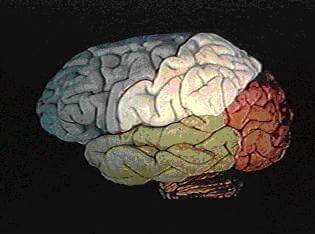
My left ear would be right in the middle of this picture. Notice the green portion of the brain: this is my temporal lobe.
It lies right under my temple and keeps a lot of remembering that I do.
And if you have X-ray vision, that blue one beneath this is my hippocampus.( Pic-2)
So what is the big deal ?
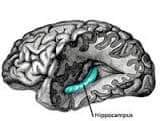
Pic-2
Well the story of hippocampus- the smelling brain is beautiful. But it was unknown before 1953.
Now we know this thanks to a man named Henry Molaison, whose hippocampi were surgically removed in 1953 during an experimental surgery designed to cure his uncontrollable epilepsy.
(until his death in 2008, he was known in the literature only as H.M., in order to protect his privacy)
The Hippocampus
Now we know more of this quaint shaped structure thanks to the experiments done by neuroscientists Brenda Milner, of McGill University, in Montreal and Suzanne Corkin, of MIT, in Boston on HM.
For example:
1. When I’m driving, I don’t pay any significant attention to the cars whizzing by on the other side of the road. But if one suddenly veers toward me, my brain goes on red alert. That’s probably my hippocampus.
2. Our memories of an incident comprises of multiple inputs ie. visual, sounds, smell or taste items. They are stored safely in separate boxes in our brain. They are further separated into time zones.
All these parcels of sights (eye brain), sounds ( hearing brain), smells, emotions, and every other aspect of a given moment, are knit into a single ‘Remembered Incident‘ in our brain that could be called up in the future and re-experienced. The job is done by hippocampus.
3. When I tell you about a third person whom you know from childhood, you start moving through memory time zones of school period, break, then post graduation period, stop and previous year’s memories easily as if shifting gears. The clutch plate is hippocampus. That ability to move back and forth between related events, separated in time, is impaired in patients with hippocampal damage.
4. Hippocampus is our map that helps us come back to our home everyday after the day’s work is over. But an Alzheimer’s cannot come back. It’s not that easy.
Before taxis were equipped with GPS, cab drivers had to memorize all the streets, routes and alternate routes a city had to offer. And since cabbies had to practice all this memorization, their brains developed a larger than average Hippocampus, the part of the brain that handles the human GPS. With the invention of GPS this has changed.
In 2006, a team of scientists studied the effect of technology over the brain of NY city cab drivers.To their astonishment, they found out that the hippocampus part of these techno savvy cabies are significantly shrunk in its size.Like muscles, when we use our grey cells, they grow. When we don’t they shrink. So our technology, is it for good or for bad ? # Sven Birkets.

