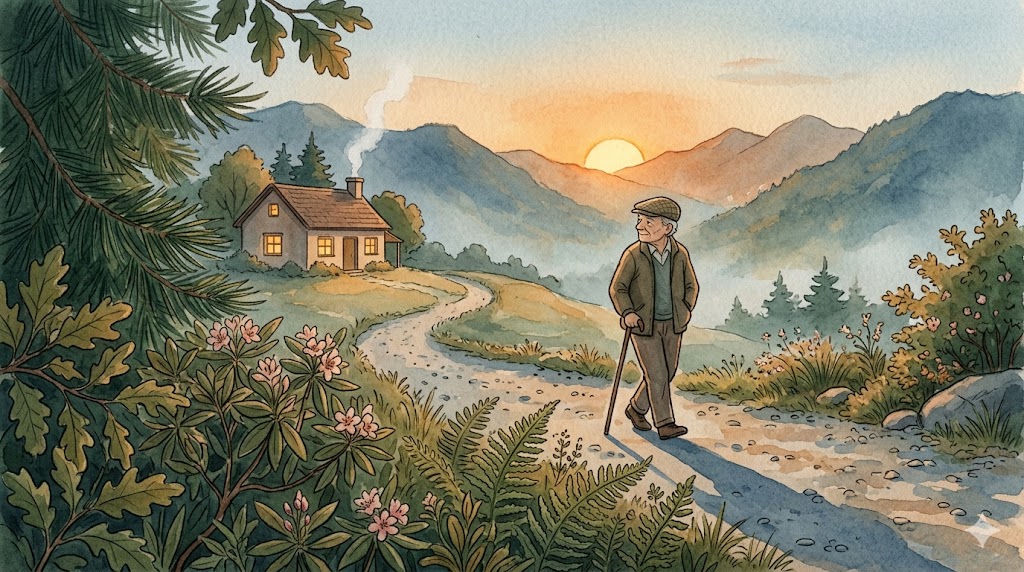
The sun was dipping behind the deodars, casting long, amber shadows across my gravel path, when I finished my afternoon meal. It is a quiet ritual I’ve come to cherish—not just the eating, but the gentle wandering that follows.
You see, our bodies are much like a small hill station’s bazaar; there is a constant bustle of supply and demand. When we sit down to a hearty plate of dal and rice, the carbohydrates transform into sugar, flowing through our veins like a mountain stream after a sudden monsoon downpour. To manage this, the pancreas releases insulin, a diligent gatekeeper that ushers the sugar into our muscle cells.
The Index of Indulgence
I’ve learned that food carries its own temperament, much like the guests who visit my cottage. Some, like a cold scoop of vanilla ice cream, have a high glycemic index; they arrive with a flourish, causing a sudden, sharp spike in one’s internal rhythm. Others—the humble lentils, the fibrous garden greens—arrive with a low glycemic index, steady and unassuming.
It isn’t just the quality of the treat, but the “load” of the entire feast that matters. One might enjoy a small sweet and remain unruffled, while another, indulging in a mountain of potatoes and fried delicacies, finds their system overwhelmed. It is these frequent, jagged spikes in sugar that weary the heart and the kidneys, more so than a steady, calm level.
The Body’s Resistance
In the quiet corners of our biology, trouble often arises when the supply outpaces the gatekeeper. In children, sometimes the pancreas is frail from the start—Type 1 Diabetes, they call it—requiring the daily tether of an injection. But for many of us, as the years pile up like fallen leaves, the insulin is there, yet the cells grow stubborn. They turn a blind eye to the insulin’s knock. This is insulin resistance.
The Hungry Muscles
This is where my evening walk becomes more than just a search for wild violets. You see, our muscles are the great consumers of sugar. When we set our legs in motion, these cells become hungry. They begin to “swallow” the sugar from our blood with a newfound greed, sometimes even bypassing the need for insulin altogether.
A Mountain Cottage Parable
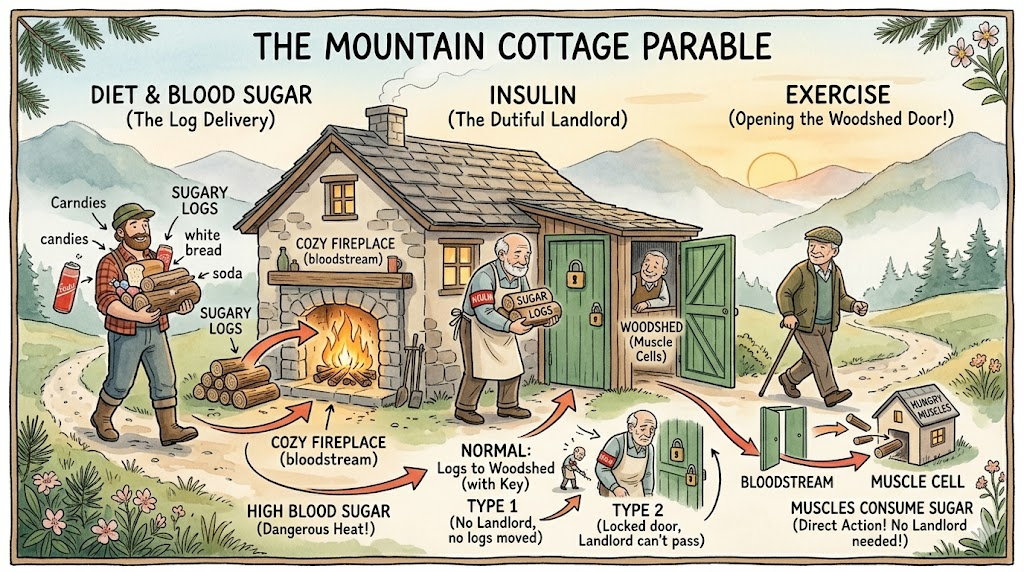
Imagine your body is a cozy, stone cottage in the hills. The diet you consume—especially those high-GI sweets and refined grains—are fresh pine logs brought to your door by a woodcutter.
- 1. The Arrival of the Logs (Diet & Blood Sugar): After a heavy meal, the logs (sugar) arrive at your cottage in abundance. If you burn too many at once, your internal fireplace (your bloodstream) gets dangerously hot. This rising heat represents high blood sugar.
- 2. The Dutiful Landlord (Insulin): Your pancreas is the cottage’s diligent landlord, Mr. Insulin. His job is to move those logs from the fireplace into the woodshed (your muscle and fat cells) for future use. When the fireplace is too full, he works tirelessly, trying to match the woodcutter’s delivery. Diabetes occurs when Mr. Insulin is absent or the woodshed door is barred.
- 3. Opening the Woodshed Door (Exercise): This is where your post-meal walk comes in. When you start walking—even a gentle stroll—you are effectively taking the logs directly out of the fireplace and tossing them straight onto the burning pyre. Your muscles create their own fire, independent of the landlord! They eagerly consume the sugar for energy, letting Mr. Insulin rest his tired hands.
My Secret
I have found there is a perfect window for this movement. About fifteen minutes after the last morsel is cleared, the sugar begins its ascent. If I lace up my walking shoes and step out into the cool air then, my muscles are ready and waiting. By walking for twenty minutes after a major meal, I am helping my body clear the path before the “spike” can do its mischief.
It is not the level of your blood sugar, but the frequent spikes of hyperglycemia do the maximum harm to our body. Unfortunately, your quarterly blood tests and HBA1c will not be able to track it.
So, if you find yourself lingering at the table, I invite you to join me. Let the dishes wait a moment. The air is crisp, the shadows are long, and your heart will surely thank you for the journey.
Here is a table of various foods as per their glycemic index
| High GI (The “Spikes”) | Low GI Alternative (The “Steady Flow”) |
| White Rice | Brown Rice or Barley |
| White Bread | Sprouted Grain or Stone-ground Whole Wheat |
| Mashed Potatoes | Sweet Potatoes or Roasted Cauliflower |
| Sugary Cornflakes | Rolled Oats with Nuts |
| Fruit Juices | Whole Fruit with Skin |
 Dr Ramakanta's Ideas