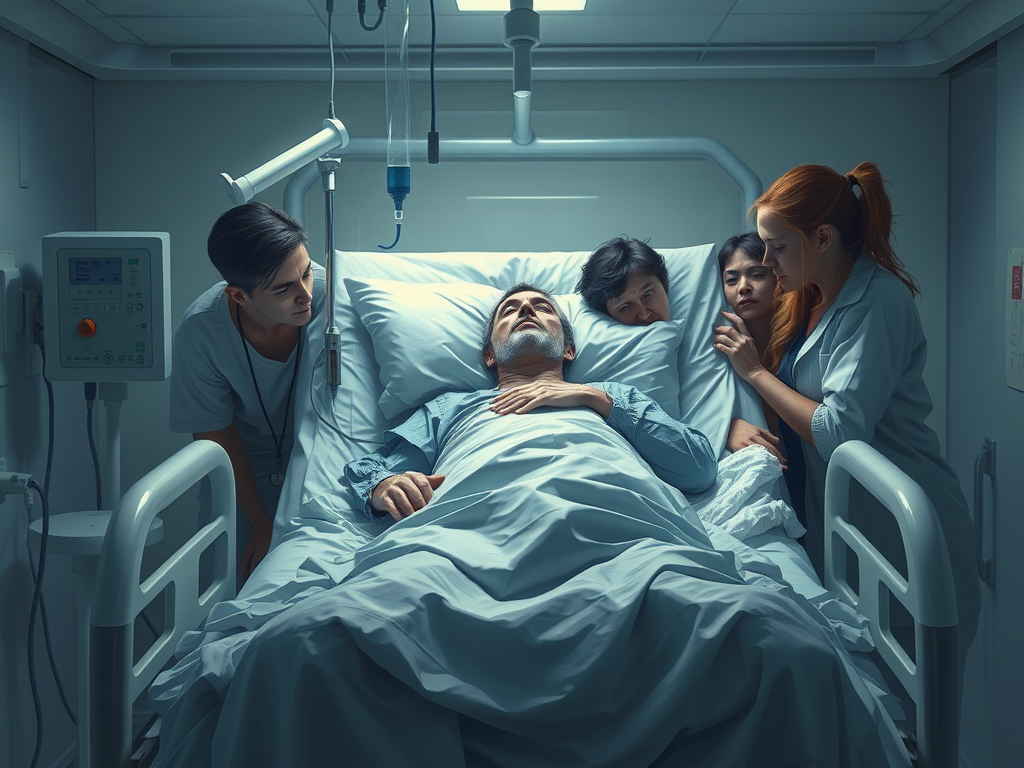
My father was 81 when he had a brain stroke in the early hours of a cold winter night. He had always been so healthy, save for the multiple treks to the bathroom in night. It was during one of these trips that it happened. He went to bath room and didn’t come back. In the morning, my mother found him seating on the toilet seat like a statue holding the steel railing.
As a doctor we were taught that elderly people often suffer brain strokes early in the winter mornings, frequently in bathroom.
He was rushed to a corporate hospital where a CT scan was taken. He had a massive blood clot that had pushed half his brain into the other half of his skull. For 21 days, he remained lost in a deep, impenetrable unconsciousness. We, his anxious family, hovered and questioned, grilling the doctors with our impossible hopes and fears. The poor physician, trapped between our frantic pleas and his human limitations, retreated into a flurry of expensive tests and exotic medicines. We bought 10 vials of a costly injection, Tigecycline, believing it might be a miracle in a bottle. In the end, we had to throw away nine of them.
Our first instinct is to see hospitals as places that prevent death. But that’s not quite right. Death is a natural, universal part of life; around 175,000 people die every day, often from causes that can’t be stopped.
The job of a hospital is not to stop death, but to fight disease.
By focusing on the fight against disease, hospitals give us the best possible chance at a long, healthy life.
We, his family, were consumed by anxiety, pestering his doctor with endless questions. The doctor, a man fighting his own battle against our fears, responded with more tests and costly medicines. The day before my father passed, we were advised to buy 10 vials of a very expensive injection. We did, believing it might save his life. In the end, we threw away nine of them.
We went to the hospital believing it could prevent death. This is what modern medicine has taught us: that technology and treatment can save a person from even the brink of death. But what can you do for an 80-year-old man whose brain has been pushed half way out of place? Even as a doctor, I believed my father could wake up with the right treatment. We opened our wallets and poured our money into a losing battle.
Doctors are trained to fight disease, not death itself, but families often can’t tell the difference. We have to learn to accept death, as we did with my father.
I observed something during his final days: the process of dying is remarkably similar, no matter what may be the illness. Energy wanes. People sleep more and more, using it as their only way to recharge. They can become unconscious for long stretches, and when they do wake up, they don’t seem to notice the time that has passed.
Towards the very end, his breathing became a simple reflex of a vegetative brain. His throat couldn’t feel anything, and sometimes a coarse, gurgling sound would emerge as air bubbled through a small pool of fluid. It was a sound that terrified us, and we would beg the doctors to do something.
We didn’t understand that he was at peace, that the gurgling sound was simply air bubbling through a small pool of fluid in his throat. We mistook it for choking, for pain. But it was just a part of the natural process.
And in the end, his last breath was nothing special. There was no rush of pain, no dramatic farewell, just a breath out that wasn’t followed by another in. He simply stopped breathing. Just like that. Death is rarely theatrical.
My father died peacefully in his unconsciousness.
Looking back on those last days, I’ve often wondered why families react with such fury at the death of their relatives. Why do they get so angry that they manhandle hospital staff or damage hospital property? I saw firsthand how my own family, consumed by grief and anxiety, put the poor doctor through hell. Why can’t we accept death as an inevitable part of life? A person who is born must, at some point, die.
Hospitals and the people who work in them are only doing their duty. They can offer treatment, comfort, and care, but they cannot prevent the ultimate end. Yet, in our most vulnerable moments, we demand that they defy the natural order of life. We expect them to perform miracles and stop something that is fundamentally unstoppable.
The anger, I’ve come to understand, isn’t truly directed at the hospital staff. It’s an expression of a profound and overwhelming grief, a rage against the helplessness and powerlessness we feel in the face of death. It’s a primal scream at a universe that seems unfair, at a life that is being taken from us. The doctors and nurses, the hospital walls—they just become a physical target for an emotion that has nowhere else to go.
Accepting death with equanimity is a skill that takes time, and most of us aren’t prepared for it. We are taught to fight for life at all costs. But perhaps the greater act of courage is not to fight death, but to accept it, to allow our loved ones to pass in peace, and to find a way to let go.
जातस्य हि ध्रुवो मृत्युर्ध्रुवं जन्म मृतस्य च |
तस्मादपरिहार्येऽर्थे न त्वं शोचितुमर्हसि || 27||
” Jātasya hi dhruvo mṛityur dhruvaṁ janma mṛitasya cha
tasmād aparihārye ’rthe na tvaṁ śhochitum arhasi. ” (2/27)
 Dr Ramakanta's Ideas