20th August, 1897 was a Friday.
It was also hot and humid at Secunderabad like any other tropical August day.
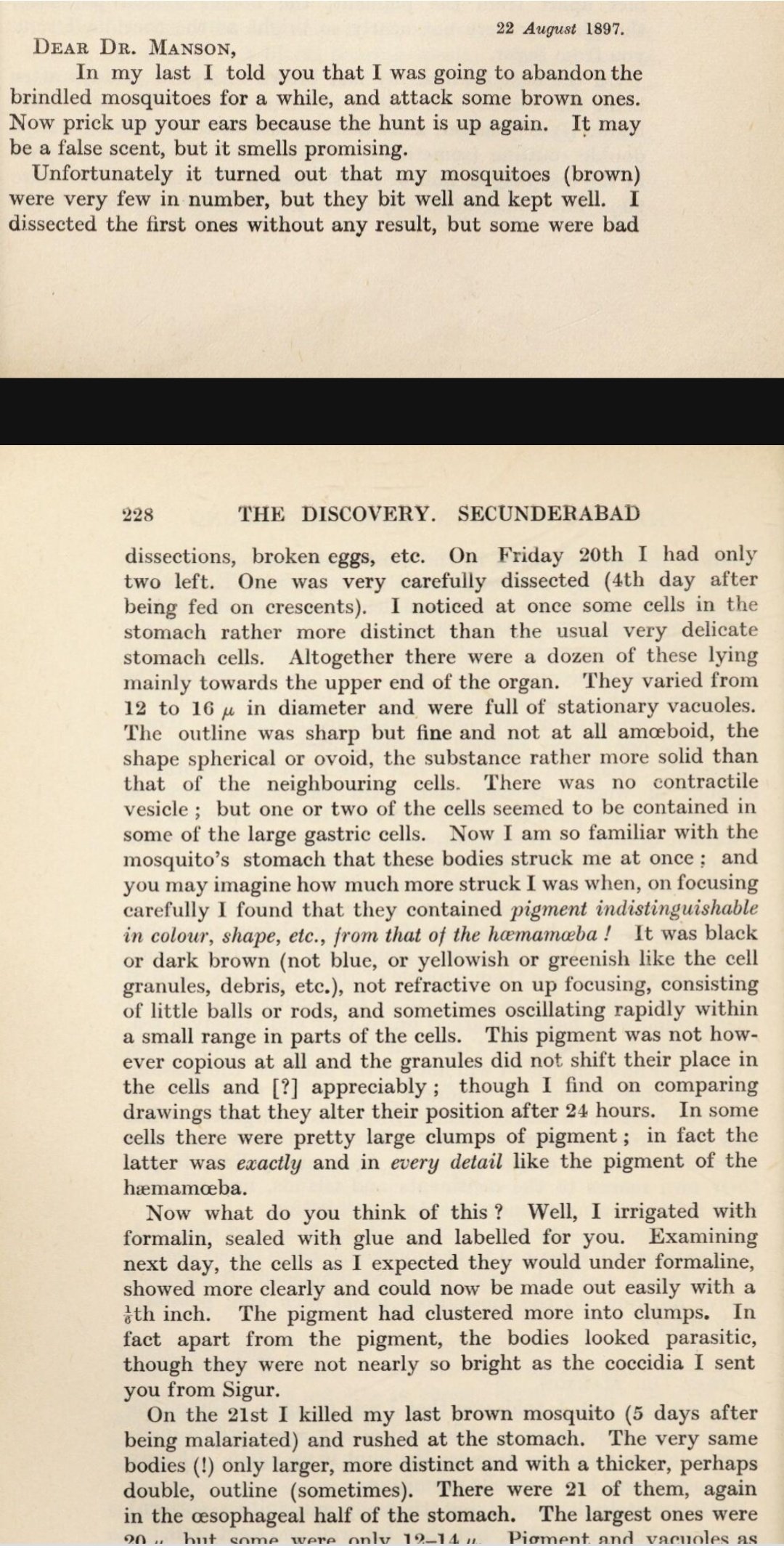
After already dissecting thousands of mosquitoes without any success, a bone-tired Ronald Ross that day looked into the stomach of the mosquito no. 38 at 1pm.
He had been looking into the eye piece of his prized microscope since 7am. His eyes were fatigued.
So he missed the pigmented vacuoles inside the stomach of the dissected stapled mosquito. It was a large female mosquito that has fed on Husain Khan 4 days ago on 16 August to be precise. He was rather confused whether these vacuoles are part of the stomach wall of the dead mosquito or parasites growing in the blood meal inside her stomach. However, he took in the illustrations and carefully noted down them in his note book. He was noted for the discipline he had brought to the lab at this South Indian town.
In the evening in the mess, suddenly the realisation struck him.

Next day, 21st August, he dissected the last mosquito of the collection and there they were 21 signet rings inside the dissected stomach of the mosquito no. 39. This time the rings have grown in size, suggesting that these parasites are growing inside the dead mosquito.
He was sure, he had found out the cause of the deadliest scourge of mankind.
The Nobel Prize in medicine 1902 was awarded to Ronald Ross for his work on malaria.
Ronald Ross Joins Indian Medical Services:
After completing his medical education in UK Ronald Ross has joined the Indian medical service in 1881. His father was an army officer in British Indian Army and posted in India. His childhood was spent in India. But his father wanted him to be a doctor and join Indian Medical Services.
After meeting sir Patrick Mason at London, ( Who gave him a new thing- a Microscope) he had landed in Bombay on 24 April. Even before his luggage was cleared in the custom office, he went straight for the Bombay Civil Hospital, looking for malarial patients and started making blood films. In June he was transferred to Secunderabad. In July 1897, he managed to culture 20 adult “brown” mosquitoes from collected larvae. He successfully infected the mosquitoes from a patient named Husein Khan for a price of 8 annas (one anna per blood-fed mosquito!).
It is a matter of pride that this Nobel prize was awarded for his seminal work done totally in India.


Interesting & well reminding.
LikeLike
Thanks
LikeLike