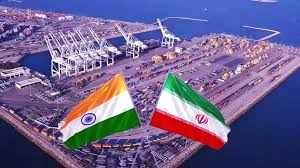
As a doctor, I tend to view geopolitics through a clinical lens. Think of the Chabahar Port as a vital organ in India’s trade anatomy—specifically, a bypass graft allowing us to reach Central Asia while avoiding the “blockage” of the Pakistani land route. It is the heart for India’s ambitious International North-South Transport Corridor INSTC from Mumbai to Europe.
In late February 2026, as Operation Epic Fury (the US-Israeli strike on Iranian assets) commenced, the prognosis for our $120 million ( Thousand crore) investment looked terminal. Yet, the outcome was a masterclass in diplomatic triage.
The Pre-Op Strategy:
1. “Zero Allocation“- In early February, the Indian government’s Union Budget 2026-27 showed a “Zero Allocation” for Chabahar. While some called it a withdrawal, it was actually a prophylactic measure.
2. By mid-January, India had already fully discharged its $120 million (~₹1,000 crore) capital commitment, installing six heavy-duty mobile harbor cranes.
The budget freeze was a “strategic pause”—cutting off new financial “blood flow” to the project just as the US “Maximum Pressure” campaign reached a febrile peak. This minimized our fiscal exposure before the sanctions waiver’s April 26, 2026 expiration date.
The Surgical Avoidance:
Precision under Fire
When the strikes hit on February 28, 2026, the precision was uncanny. It was the geopolitical equivalent of a targeted biopsy—removing the malignancy while sparing the healthy tissue.
The Pathology:
Iranian naval headquarters and an Alvand-class frigate at the nearby Konarak Base were neutralized.
The Survival:
Satellite imagery from March 2, 2026, confirms that the Shahid Beheshti Terminal (India’s commercial terminal) suffered 0% physical damage.
This wasn’t luck. It was the result of quiet diplomacy—likely coordinated during the Prime Minister’s high-stakes visit to Israel just 24 hours prior. India effectively secured a “No-Fly/No-Strike” status for its coordinates, ensuring our infrastructure remained intact while the surrounding military landscape was decimated.
April 2026 and Beyond
Currently, the port is in a state of “induced coma”—physically sound but operationally stagnant.
The Waiver Clock: The current US sanctions waiver expires in seven weeks.
The Political Variable:
If the regional escalation leads to a regime shift in Tehran by April, we could see a full-scale resuscitation of the International North-South Transport Corridor (INSTC).
For now, India’s assets are safe, the capital is “sunk” but protected, and we are simply monitoring the vitals. In the world of high-stakes diplomacy, sometimes the best surgery is the one where the patient—our investment—doesn’t even feel the blade.
 Dr Ramakanta's Ideas