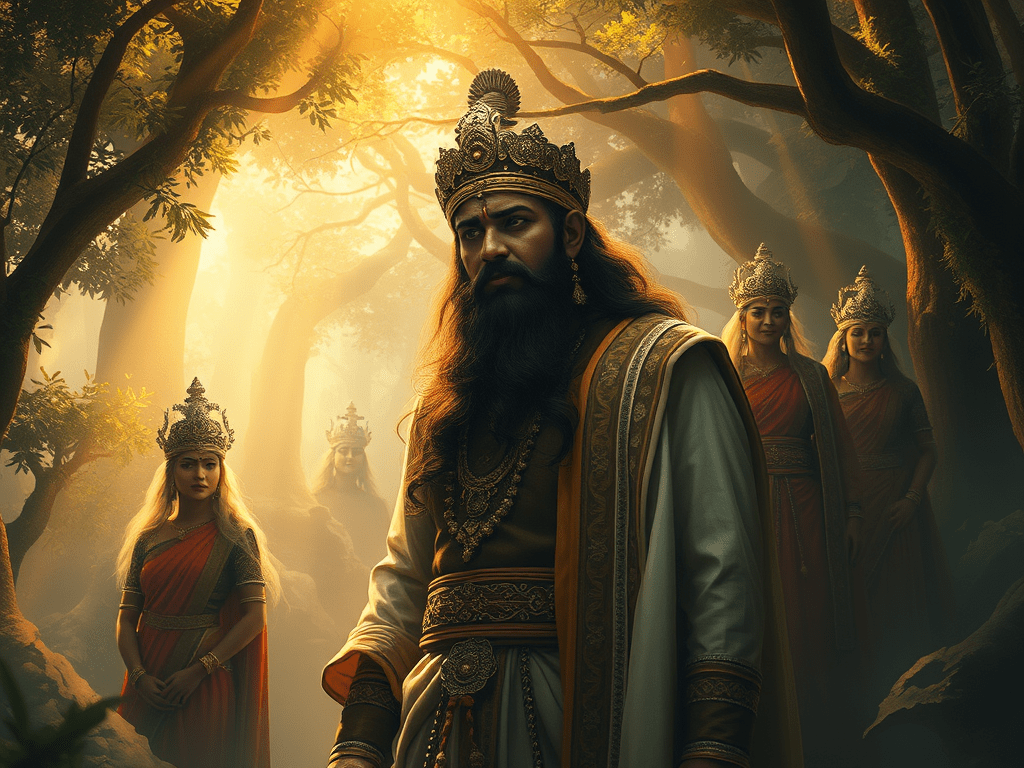
"The story of the King Salivahana, the poet Gunadhya, the Kathasaritsagara in Paisachi is one of the most tragic and fascinating stories in Indian literature."
Today we know that the gigantic collection of stories Kathasaritsagara is actually just a tiny surviving fragment of a much larger, lost epic called the Brihatkatha.
Here is the story of how a grammatical mistake by a king led to the burning of one of the world’s greatest books.
1. The King’s Humiliation
The story begins in the court of King Salivahana (often identified with the Satavahana dynasty in Pratisthana, modern-day Paithan). While Salivahana was a great conqueror, he was uneducated in Sanskrit grammar.
One day, while playing in the water with his queens, he splashed water on one of them. The queen, tired of the splashing, cried out in Sanskrit: “Modakaih tadaya!”
The king could not understand. All the queens laughed. Humiliated in front of his court, the King fell into a deep depression and refused to eat until he could master Sanskrit.
2. The Great Wager
The King had two ministers – Gunadhya and Panini.
Gunadhya told the King it would take twelve years to master Sanskrit grammar.
Panini claimed he could teach the King in just six months.
Gunadhya found this impossible. In a fit of pride, he made a terrible vow: “If you succeed in teaching him in six months, I will forever renounce the use of Sanskrit, Prakrit, and the vernacular languages of men.”
Panini accepted. Using a simplified grammar technique, he successfully taught King Salivahana within six months. Gunadhya lost the wager.
3. The Language of the Goblins (Paisachi)
True to his word, Gunadhya silenced himself. He could no longer speak or write in the languages of the elite (Sanskrit) or the common people (Prakrit). He retreated into the Vindhya forests.
There, he encountered the Pisachas (goblins or spirits). Since he had not renounced the “language of the goblins,” he learned Paisachi (a now-extinct or lost dialect).
In this strange, rough tongue, he decided to compose a massive epic. Lacking ink and paper in the wild, he used his own blood as ink and wrote on tree bark. Over seven years, he wrote the Brihatkatha (“The Great Story”), a massive epic of 700,000 verses— seven times the length of the Mahabharata.
4. The Rejection and the Fire
Gunadhya sent the manuscript to King Salivahana, hoping the King would appreciate the literature despite their past rivalry.
However, King Salivahana rejected it with disgust as It was written in Paisachi
(considered a lowly, “barbaric” language) and also in human blood
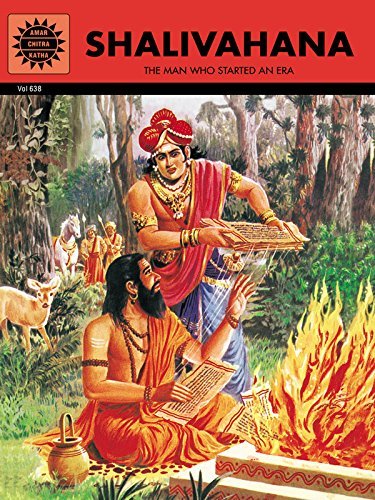
Heartbroken by the rejection, Gunadhya climbed a hill in the forest. He lit a large sacred fire. He began to read his epic aloud. As he finished reading each page, he threw it into the fire.
The story was so enchanting that the deer, boars, and birds of the forest stopped grazing and stood motionless, weeping as they listened.
5. Saving the Fragment
Meanwhile, King Salivahana fell ill. His doctors prescribed game meat, but the hunters returned empty-handed. They reported that all the animals in the forest had starved themselves because they were too busy listening to a wild man reading stories on a hill.
Curious, the King went to the forest. He saw the emaciated Gunadhya reading to a trance-like circle of animals. The King realized that this “wild man” was his old minister Gunadhya and that the work he was burning was a masterpiece.
The King rushed forward and grabbed Gunadhya’s hand, begging him to stop. But it was too late. Gunadhya had already burned six of the seven books (600,000 verses). Only one book—the seventh—remained.
The King took the surviving manuscript back to his palace and decreed that it be preserved and translated.
6. The Legacy: Kathasaritsagara
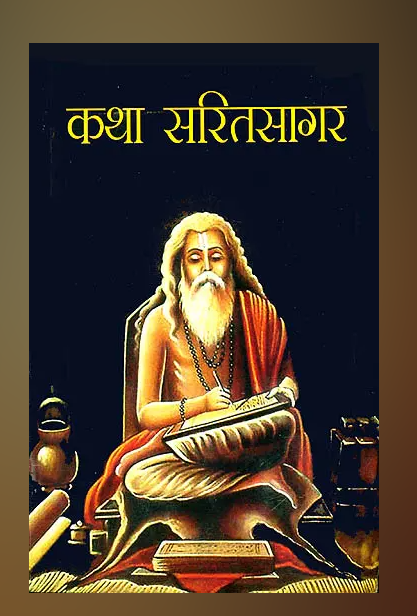
Kashmiri poet Somadeva created Sanskrit adaptations of the Brihatkatha. It was today known as the Kathasaritsagara.
NB-
The Kathasaritsagara is arguably the largest and most complex collection of stories ever produced by a single human mind. It is nearly twice as long as the Iliad and the Odyssey combined.
The Nested Stories:
As the king in the story travels, he meets people who tell him stories. The characters in those stories tell other stories. It is not uncommon to be five or six layers deep into a narrative.
Stories from the Kathasaritsagara migrated westward via the Silk Road to Persia. They formed the skeleton of the Arabian nights and the famous Grimms fairy tale of Europe.
[ Retold ]
 Dr Ramakanta's Ideas