
The Great Plague of Athens : 430 BCE
In 430 BC, a plague struck the city of Athens, which was then under siege by Sparta.
We know that the city state of Sparta and Athens were at war for centuries. The word Marathon has originated from one such episode of war way back in 490 BCE, 60 years ago. That war was won by Athens. But this time they were not so lucky. Because they had to fight and defend against two simultaneous attacks, one from outside- the siege of Sparta and the other the Great Plague of Athens from within.
Although this time also, the Athenians were about to win the war under the able leadership of Pericles, their greatest leader, a great plague struck the city in 430 BCE and killed almost one third of their population. The plague.
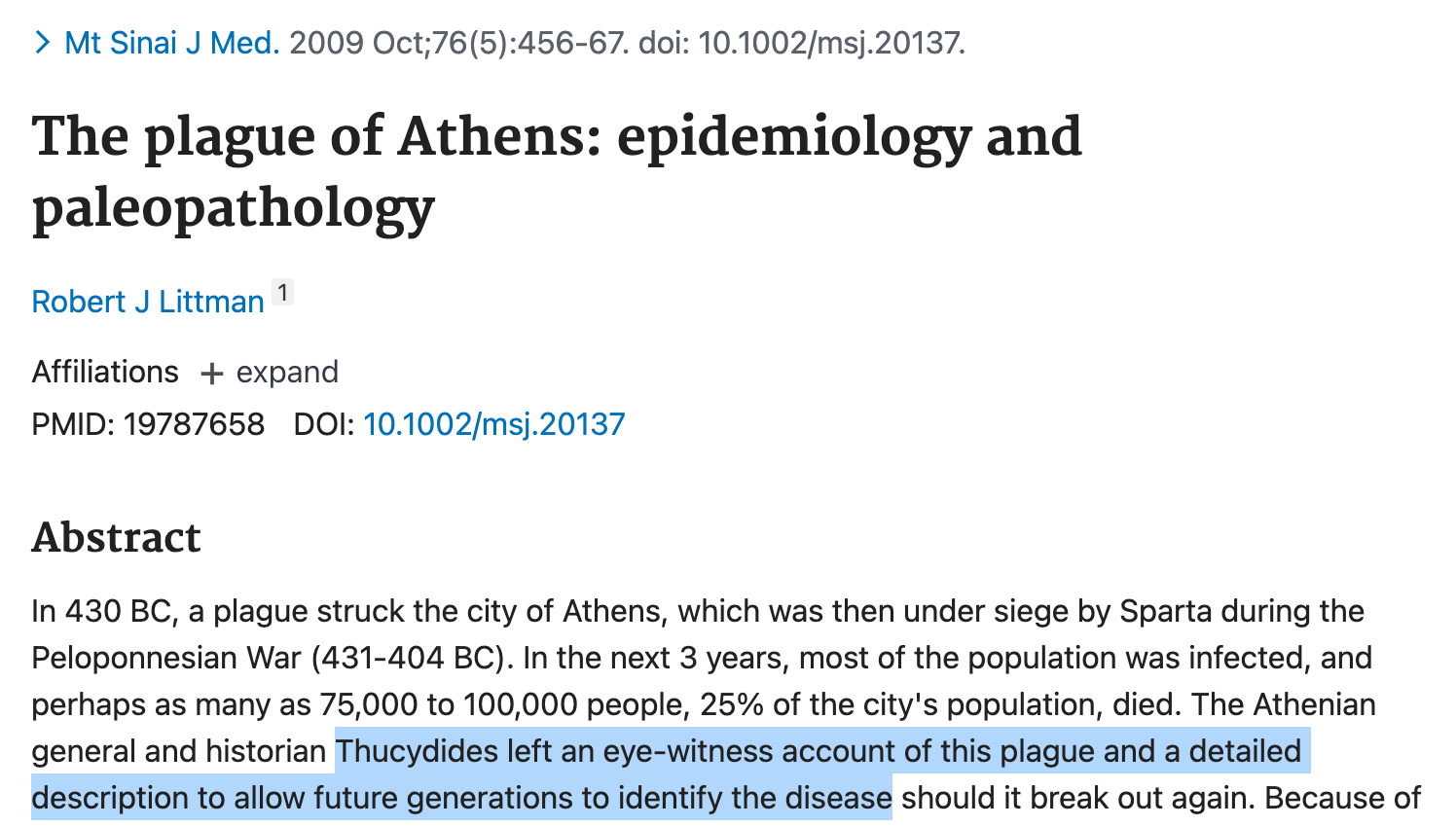
Thanks to Thucydides, the historian and a general of Pericles, we get an accurate, eye-witness and written record of the great plague.
2500 years ago, in 430 BCE, Thucydides has made one of the most enduring observations in the history of medical science.
The plague affected both the kings and commoners of Athens alike. It was so infectious that nobody dared come near a person with the pustules, leave aside taking care of the sick. Soon the great nobles of Athens were left without any one to take care of their sick family members despite their enormous wealth and power. The plague was such a leveller !
Then Thucydides wrote one of his immortal lines.
“Nearly one third Athenian perished. Rest were disfigured with scars on their face and eyes. But those with such scars, those who had survived the scourge were exempted from another second affliction. They can be used as Caregiver for the sick without fear.
The latin word of Exempt is IMMUNE from which has come a whole branch of medicine Immunology.
Today we are pretty sure that the plague described by Thucydides is most likely an epidemic of Small Pox. It most likely entered the ports of Athens from Ethiopia as Sparta had led siege to all the land borders of the Athens. It ravaged the famous city-state for 3 consecutive years: 432 BCE to 429 BCE. It killed nearly 75,000 to 100,000 athenians alone. Pericles died in 429 BCE.
[ In the literatures of two other ancient civilisations ( India and China) we also get reference of life long protection conferred from one attack of Small Pox, Shitala Mata in India, but the record of Thucydides is more famous in western world. So is the word Immunity in our medical science.
Immunity in latin means Exemption from another attack. This Latin word has spun a whole branch of modern medicine today- Immunology.
The Athenians had no idea what caused Small pox. Neither in India nor China. In India people worshipped small pox as the goddess Shitala Mata. But mankind as a whole, in Geece, China and India had one important observation.
“One attack of Small Pox confers life long protection against the scourge.”
Which also implies that if small pox could be artificiallly induced in a healthy human being and he survived, he would be protected for the rest of his life.
This is the principle of Variolation. It was dangerous. Some of the variolated cases can develop full blown disease. Yet, mankind was ready to take this risk than contract Small Pox, such was the terror it caused. Much more than Covid-19.
Variolation continued till Edward Jenner discovered Vaccination.
 Dr Ramakanta's Ideas