
Charles was a worried man as he alighted at the Market Drayton.

Market Drayton was a small market town in the north Shropshire, England, close to Cheshire.
In 1245, King Henry III granted a charter for a weekly Wednesday market.
This gave the town its current name.
A visibly worried Charles had no reason to relish this ancient history of the market here. He had been summoned by the market people to take his trouble maker 17 year old son back home.
Apparently Bob was the leader of a gang of teenager who were running a protection racket and were extracting monthly donations from the business folks of this market town. He had been expressly summoned by the market people for one such misdeed of his son. Apparently, a respected marketeer had refused to pay the protection money and Bob in a fit of anger had mowed down the sewerage drain wall resulting in flooding of the poor man’s residence.
Bob had been a trouble maker and fight-monger right from his childhood. At the age of 7, he had climbed up the tallest tower of the local church to frighten boys older than him. In desperation his father had packed him to his uncle’s place in Drayton away from the bad influence there. Instead of concentrating on his studies, he had been busy threatening boys older than him in the school. His uncle would remark, “Bob was addicted to fighting. But in a situation of escalation, he had the exceptional skill to right size his opponents and snatch victory audaciously from the mouth of sure defeat.
What a reputation ! Charles shied.
He had a contact in the London office of EIC, a British trading office. They had been importing Tea, spices, Cloths, Silk from south Asian countries and selling them in the European markets. The Company was making good business. What is important, it had been a shelter for most of the good for nothing British youths who are unemployable inside England because of their criminal background.
Bob was going to India. He said.
A Chance Survival
So on December 15, 1742, 500 years ago to this day Bob Clive boarded a ship to India. In those days, ships would sail from England to Brazil round the cape of Good hope and took months to reach Asia, the land of riches, gold and spices. Half way into the voyage, near Brazil, Bob had slipped and drowned in the sea. It was sheer chance that he was noted by a sailor and was rescued.
In the March of 1743, the ship anchored at Madras and Robert Clive reported to the office of British East India Company at Madras as a writer ( Junior most Clerk).
He would hate every moment of his stay in that office. Certainly he didn’t have patience to pour his days into the thick finance ledgers of the company. Instead, he would pick up fights with his colleagues quite often. He was addicted to fighting. He even quarrelled with the secretary of Fort St George. That costed him a written apology. He became desperate, home sick and tried to commit suicide. Then he was taken as prisoner.
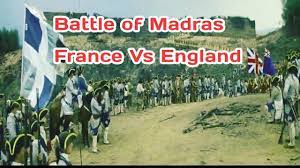
The East India Companies of all the European nations ( Dutch, British, French) have started as business houses trading in spices, tea and other Indian goods in the European market. But soon they took charge of collecting revenue on behalf of the local kings and maintained their own small army for this. In no times, they escalated their position to lending mercenaries to the local rulers in return of good money and sided with one or other of the feuding rulers. It was inevitable that the interest of two foreign forces French and British would collide. Britain and France were fighting the 7 year anglo-french war in Europe. How can their representatives in India live in peace ?
On 4 September 1746, Madras fell to French and all the British residents including Clive were taken prisoner. While others bowed to the terms of French, Robert Clive and three others disguised themselves as natives and escaped from the fort. They walked all the way to the British fort of St David 80 kms away. That is when Clive demoted himself from the respectable Clerck post to a foot soldier in the army.
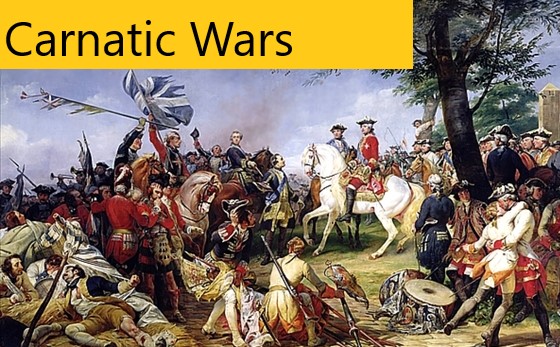
By this time, both the British and French off Coromandel coast had dropped their cloaks of simple merchants and were actively taking side in the vicious succession wars of petty Indian Nawabs.
When the Nawab of Carnatic died in 1749 in Arcot, a war of succession arose between his two heirs: Chanda Sahib and Muhammad Ali. French supported Chanda Sahib and muscled him on the throne of Arcot. British had to support his opponent Muhammad Ali in Trichinopoly and lost the game. The new Nawab and his French allies led a siege to the fort Trichinopoly and were sure of a win. The wars in indian sub continent in those days were fought at a leisurely pace. Soldiers would stop fighting after the sundown and would pass the night in merry making.
Robert Clive however had a different plan. Half way into a stormy night, Clive and his 200 British soldiers moved fast under the darkness of night, stormed the fort and defeated the cavalry of 4000 Indian and 100 French soldiers of Chanda Sahib.
It was an impossible and audacious move. It may have been luck, it may have been error on the part of Indians. But it created the legend of English courage and invincibility.
I always believe the seed of the British Empire was sown on that stormy night at Arcot.
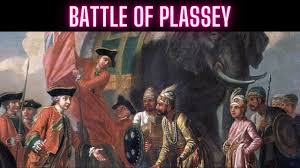
Six years after this date, the same audacity and invincibility was again displayed by Robert Clive in the battle of Plassey. Siraj-ud-Daulah’s army of 50,000 was defeated by Clive’s 3000 in the former’s home ground. In this war, Robert Clive has resorted to all the nefarious tricks that he had learnt during his gangster days at the Market Drayton like. Bribing Mir Jafar, the commander in Chief of the nawab, playing the Hindus Jagat Seth, Omi Chand against the muslim Nawab and so on. The ruthlessness, audacity and lack of principles would be the hallmark of every move of the East India Company in the next few years. In those short period, the Company would defeat the powerful Mughals and Nawabs of India to chuck out the biggest, richest and mightiest colonial empire in the history of world. The foundation of the mighty British Empire for the next 200 years were laid in those battle fields.
During his illustrious career, Robert Clive had often resorted to unscrupulous principles, unbelievable audacity that had produced rich dividends to the Empire. The British Government was very much aware of his activities. It even went on to institute an enquiry against him only to exonerate him from every charges.
Once at the markets of Drayton, he would use his intuition, sixth sense, guts and audacity to extort money from the vein business men for personal gain. Now he would use those very qualities to extract millions from the vein Nawabs and Kings of the subcontinent in the name of protection money and salt them away in England.
. He would use Bribing, extorting, ditching and divide & rule to run down the richest and biggest empires of his contemporary history.
The seed of British Empire had been sown in the small market town of Drayton where a 7 year old trouble maker kid grew up to lead a protection racket gang and vandalised the shops of uncooperative merchants of market Drayton.
So unforeseen yet how true.
 Dr Ramakanta's Ideas
Great
LikeLike