
Casimir Funk thought that deficiency of amines like Thiamin were causing diseases like Beriberi, Scurvy and Rickets. It was a radical change from Koch, Pasteur’s infection theory as the cause of all diseases. He called tham the Vital Amines. We still call them Vitamins.
In 1883, Dutch military physician Dr Christiaan Eijkman was posted in Indonesia. Indonesia was occupied by the Dutch at that time. It was called the Dutch East Indies. In their eagerness to discover a sea route to India, the land of Gold, the European nations had named every new island they discovered on their way as India. Columbus had travelled west and reached the Barbados. He had named the islands as West Indies. The name had struck. Dutch had travelled east and reached Indonesia and had named it East Indies.
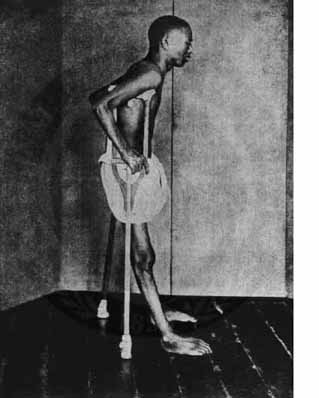
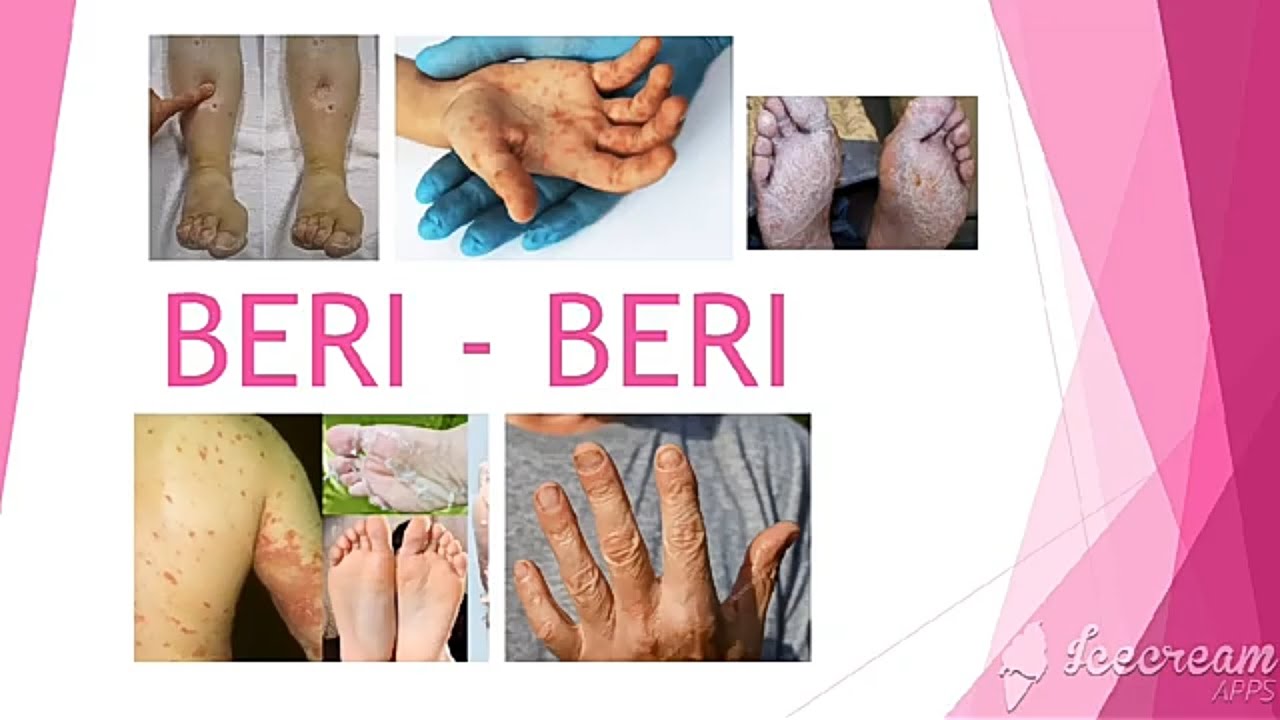
( A case of Beriberi)
In those days, the whole of the Dutch Army in Indonesia was down with an unknown neuritic disease which today we know as Beriberi. Soldiers would get paralysis of their hands (wrist drop) and could not fight. In the 1890s, Dutch were quite sure that it was another infection spreading fast. Eijkman was sent to find out the organism.
Those were the golden days of Infectious diseases. Robert Koch had just discovered the Mycobacterium tuberculosis and had established the Koch’s postulate to identify any pathogen. The old miasma theory had been replaced by the Germ theory of diseases.
( Prior to Koch and Pasteur, people thought that diseases were caused by the frown of gods or circulation of bad air ( eg. Mal-aria). Accordingly sick villagers would visit temples for curing diseases while their urban counterparts would visit sanatoria for change of air.)
As soon as the koch’s postulate gained ground, slew of infectious diseases were decoded. Soon Pasteur, Loffler, Yersin went on to discover organisms that caused Anthrax, Cholera, Plagues in quick succession.
Eijkman was sure he would find out the bug that was causing Beriberi.
In 1887, Eijkman was made the director of Javanese Medical School and was sent to Dutch East Indies. Immediately on arrival, he had set out in applying the principles of Koch’s postulate to all his cases. He would draw blood from the affected soldiers and inject it to chickens with the hope of transmiting Beriberi to the chickens.
Soon these chickens also displayed the symptoms of neuritis. Excited, Dr Eijkman drew blood from these symptomatic chickens and injected them to others. To his utter surprise, soon the whole flock of his chickens, both cases and controls were down with Beriberi. What a virulent bacteria!! he exclaimed.
Then the military cook brought a basket full of cooked rice to feed the chickens. Normally, the chickens were fed with the local cheap brown rice. Polished white rice was reserved for the officers’ mess.
The cook explained that the consignment of chicken feed was delayed by one month. So he was feeding the birds with white rice from the officers mess.
As soon as the regular consignment of chicken feed brown rice arrived, Eijkman observed that all the infected birds were cured. He now set himself upon isolating the bug in polished rice that was responsible for the infection.
But in spite of his best efforts, he was unable to transfer the organism from one animal to another by blood. ( This is mandatory to establish the Koch’s postulate.), He was sure it was the white polished rice that caused Beriberi in his chickens. Brown rice was able to cure the neuritis condition of the birds. After several rounds of controlled trial, he failed to identify any bug that might have caused Beriberi.
The Koch’s postulate was so pervasive in the medical field of 1890s, that Dr Eijkman could not throw away the infective theory completely. Instead, he reported that some infection or toxin in the polished rice was giving rise to beriberi in birds. The husks of the brown rice was able to lock off the toxin and was preventing the release of such toxin.
…
It took 20 more years to break down the voodoo of the “Germ theory as the universal cause of every single disease” when Dr Casimir Funk extracted Thiamin, an amine from the husk of rice. He went on to establish that though our body requires a very minute amount of thiamin, yet the deficiency of Thiamin led to Beriberi. He also postulated that our body needs many more such Vital Amines in very minute quantities, Yet deficiency of such can cause Scurvy, Rickets and so on.
He called these substances Vital Amines or Vitamine. Later on we knew that all these essential things are not amines. So one E was deleted from the end, we called tham Vitamins as a whole.
This broke down the 100 year concept of searching for an infective cause of each and every disease. The concept of Nutritional deficiency causing disease gained ground.
Dr Casimir Funk’s theory was so persuasive that by 1929, in just 20 years, all the 13 Vitamins were discovered. A new class of diseases called Deficiency diseases were created. A new subject was added to our knowledge sphere- Nutrition.
Dr Eijkman was awarded the 1929 Nobel prize for his discovery of cause of Beriberi.
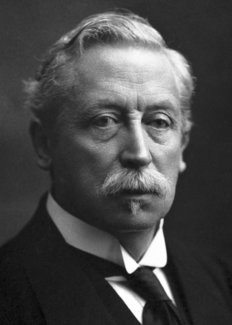
(Dr Christiaan Eijkman)
Chance has played a role in the discovery of many such medical advances. Here's another example:
In 1889, a lab assistant of an experimental surgery department noticed that a large number of flies were swarming about the urine of a dog in his lab whose pancreas has been removed. Analysis of this urine was found to be rich with sugar. This chance observation established the fact that some Pancreatic substance prevented diabetes. Frederick Banting and his colleague Best got the powder of pancreas from healthy dog and were able to keep this dog alive for 70 days by injecting it their pancreatic extract. Banting was awarded the 1923 Nobel prize for discovery of Insulin.)
 Dr Ramakanta's Ideas