Those Barber Surgeons
Those were the days when as you went for a hair cut, your barber would trim your hairs inside your nose, pick any thing stuck inside your ear canal as he would use a sharp blade to pare your nails. Barbers were adept in using sharp blades on human skin. They would also look inside your mouth to pull any painful dead teeth out and might pare a corn on your foot.
The barber chair is so convenient to take a nice peek inside your mouth that the barbers continued to be Dentists long after the surgeons have driven them out from tinkering with other part of our body.
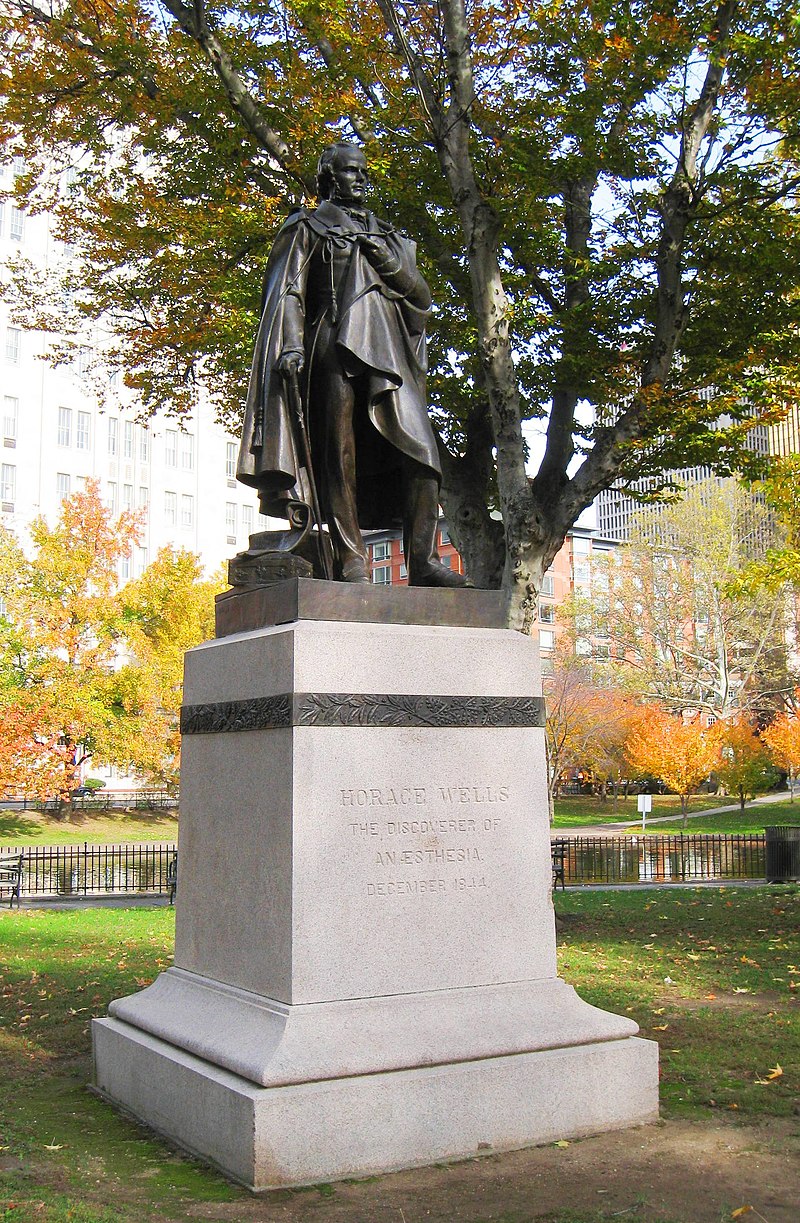
Horace Wells
Horace Wells had trained in dentistry. There were no formal Dental colleges in 1840s. He had set up a good Dental practice in Connecticut. He was a humanist. He would lay great stress on dental hygiene and use of toothbrush unlike other barbers. He was also disturbed by the pain of his dental patients.
Anaesthesia had not come yet. Pulling out one wisdom teeth was the most painful affair. Wells was always on the look out for a way to reduce the pain of his patients during the dental procedures. One day he attended a demonstration of the laughing gas, the nitrous. In the experiment one person became so intoxicated that he injured his leg dancing. But he did not feel any pain.
Dr Horace Wells next day asked his assistant Dr Riggs to put him on Nitrous and pull his caries wisdom teeth out. ( Dr Riggs later on discovered Riggs disease or pyorrhoea of mouth.) It was successful and he felt no pain. Wells went on to use nitrous oxide on at least 12 other patients in his office.
This is the record of first painless surgery in the history of medical science. That was fantastic.
Surgeons all over world were limited by the pain associated with surgical procedures. So on January 20, 1845, Dr Wells visited the most famous medical community of his time, the Massachusetts General Hospital in Boston to give a demonstration of his new discovery of painless surgery to medical students. It was a good gathering as painless surgery was a huge thing in those days.
However, the gas was improperly administered and the patient cried out in pain. (The patient later admitted that although he cried out in pain, he remembered no pain and did not know when the tooth was extracted.) The audience of students in the surgical theatre jeered and called him humbug.
Dr Wells was so embarrassed of his failed demonstration, that he almost stopped his practice and soon became ill. His dental practice became sporadic. It is now on record that Wells closed his office nine times and relocated his practice six different times due to ill health. Yet no disease could be found.
On January 24, 1848, on his 33rd birthday, he committed suicide. At that time he was experimenting the effect of Chloroform on himself. Finally William Morton a colleague dentist with whom he had shared dental practice earlier would discover Ether– the present day anaesthetic. Our modern surgery could evolve only after that.
…
Twelve days before his death, the Parisian Medical Society voted and honoured him as the first to discover and perform surgical operations without pain.
Twelve days before his death, the Parisian Medical Society voted and honoured him as the first to discover and perform surgical operations without pain. In addition, he was elected an honorary member and awarded an honorary MD degree. However, Wells died unaware of these decisions.
Wells first voiced his concern for minimising his patient’s pain during dental procedures in 1841. He was simply too much caring about his patient’s comfort.In 1840s, he would advocate for regular check ups for dental hygiene, and had started the practice of paediatric dentistry.
Not always Fortune favours the brave. The person who had performed the first painless surgical operation had to die in ignominy.
Today, A monument to Horace Wells was raised in the Place des Eats-Unis, Paris. Hartford Connecticut has a statue of Horace Wells in Bushnell Park.
 Dr Ramakanta's Ideas