
One of the greatest songs ever written in Indian history is a tragic Thumri by Nawab Wajid Ali Shah of Awadh.
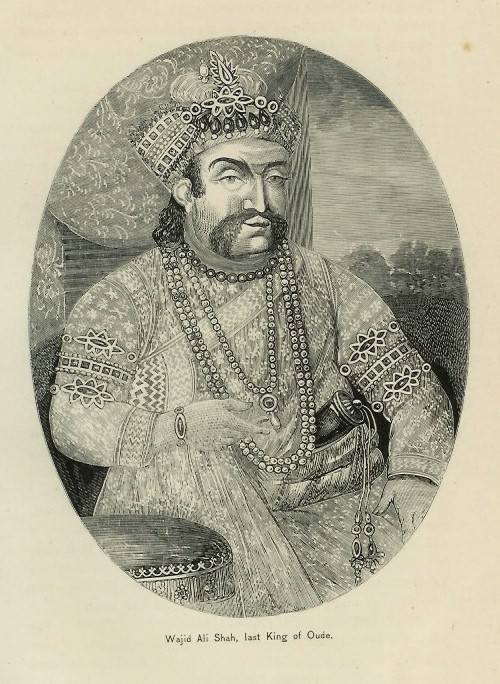
Wazid Ali Shah, the last King of Awadh
Mirza Wazid Ali shah, was the eleventh and last King of Awadh. He had hold the position for 9 years, from 13 February 1847 to 11 February 1856 and was widely regarded as a debauched and detached ruler.
British had a reason to defame him before deporting him.
Today, we know that Wazid Ali Shah was generous, kind and compassionate towards his subjects. He was also one of the most magnanimous and passionate patrons of fine arts in the Indian tradition. He had retrieved Kathak from the arena of Tawaifs and gave it a definite form, made it more artistic, and gave to it an aesthetic touch. He enriched it with rasa and bhava, and added literature to it, lent it sensuality. The result was the song “Babul Mora.. in Raag Bhairavi“.
When he ascended the throne, he took keen interest in the administration of justice, introduced reforms, and reorganised the military. He was intentionally defamed by the British Resident Commissioner of Lucknow, so that the British could find a basis for the illegal annexation of Oudh.
Recent studies have, however, suggested that Oudh was neither as bankrupt nor as lawless as the British had claimed. In fact, Oudh was for all practical purposes under British rule well before the annexation, with the Nawab playing little more than a titular role. The Bengal Presidential Army was recruited largely from Oudh. It was under the direction of the Governor-General Lord Dalhousie in 1855, all the tax revenue from Oudh was appropriated by the East India Company. This has led to the wide spread poverty and plight of the people of Awadh.
On the other hand the last Nawab of Awadh had written over 40 works, poems. The day he heard about the exile, he composed these soul scorching lines in urdu. It reads:
Babul Mora… My father!
"बाबुल मोरा, नैहर छूटो ही जाए.
चार कहार मिल, मोरी डोलिया उठायें
 मोरा अपना बेगाना छूटो जाये |

अंगना तो परबत भयो और देहरी भयी बिदेश
जाए बाबुल घर आपनो
 मैं चला पिया के देश |
"I'm leaving my father's home.
The four bearers have come to lift my doli.
I'm leaving those who were my own.
Your courtyard is now like a mountain,
And the threshold, a foreign country."
The lyric creates the agony of a Bidai : A Dulhan whose palanquin is ready with four bearers, or a dead man whose 4 coffin bearers have arrived.
Or is it that..
..the steamer Macleod has arrived to pick up Nawab from Awadh to Kolkata and to a life of house arrest.
After close to 75 years of it being released (for the 1938 movie, Street Singer in the voice of KL Saigal) this quintessential Bidai song still represents a genre of pre independent Bollywood music.
It has two subtle connection to Indian Railways.
On May 6, 1856, a steamer named General McLeod docked in Calcutta. On board was Wajid Ali Shah, the last Nawab of the Kingdom of Oudh. He was supposed to travel all the way to London to put his case before the Queen against lord Dalhousie who had usurped his throne.
Little did he know that he would never return to his capital Lucknow and it started the beginning of a home in exile.
There were 13 large mansions each surrounded by beautiful gardens on a two-and-a-half mile stretch along the Hooghly’s bank. The Garden Reach.
Nawab Wajid Ali Shah was cofined to the Bungalow no 11. Today it is better known as the BNR house- the residence of GM, South Eastern Railways.

BNR House in Garden Reach is the prettiest of all the bungalows on the Hooghly.
It belongs to the South-Eastern Railway (once known as BNR). It is dainty and small. It has a garden with flowerbeds in front and serves as the residence of the general manager.
It was constructed in 1846 and its design was apparently inspired by the Temple of Winds of Athens. The latter was also the inspiration behind Metcalfe Hall on Strand Road.
In those days, it was called Parikhana. The Garden Reach area was called Muchikhola.
The other important persons who also resided here were Sir Lawrence Peel, the chief justice of India in the 1850s, Sir TR Wynne, the first agent of BNR. He had lived in this house from 1897 to 1902 along with Lady Wynne, his children and grandchildren.
Earlier these premises also housed the Central Hospital, whose dental clinic had equipment imported from Czechoslovakia.
The building is raised on a solid but ornamental basement and columns that are 36 feet in height and 28 in number. Originally the rear of the building had six more pillars, which have been demolished. The agents’ jetty is still used as a ferry ghat to embark on launches to reach Howrah and Shalimar on the opposite bank.
One day, a young man of about 30 years of age came to Shambhuji Maharaj to learn the singing of ‘Babul Mora’. He was working in the Punjab Railways. The maestro taught him the raag within three days. The boy was Kundan lal Saigal. It went on to become the most popular one of his life time.
The list of luminaries who sang ‘Babul Mora’ includes- Bhim Sen Joshi, Kesarbai Kerkar, Siddheshwari Devi, Rasoolan Bai, Khadim Hussain Khan, Mushatq Hussain Khan, Girija Devi, Kishori Amonkar, Jagmohan, Padma Talwalkar, Shanti Vaidyanathan Sharma, Mahender Chopra (son-in-law of K.L.Saigal) and none other than ghazal queen, Begum Akhtar.
My favorite: “Bhimsen Joshi’s Babul Mora..” plugged to ear at 5am every morning across the rolling Meadows. Raag Bhairavis are at their best early in the early morning.
 Dr Ramakanta's Ideas